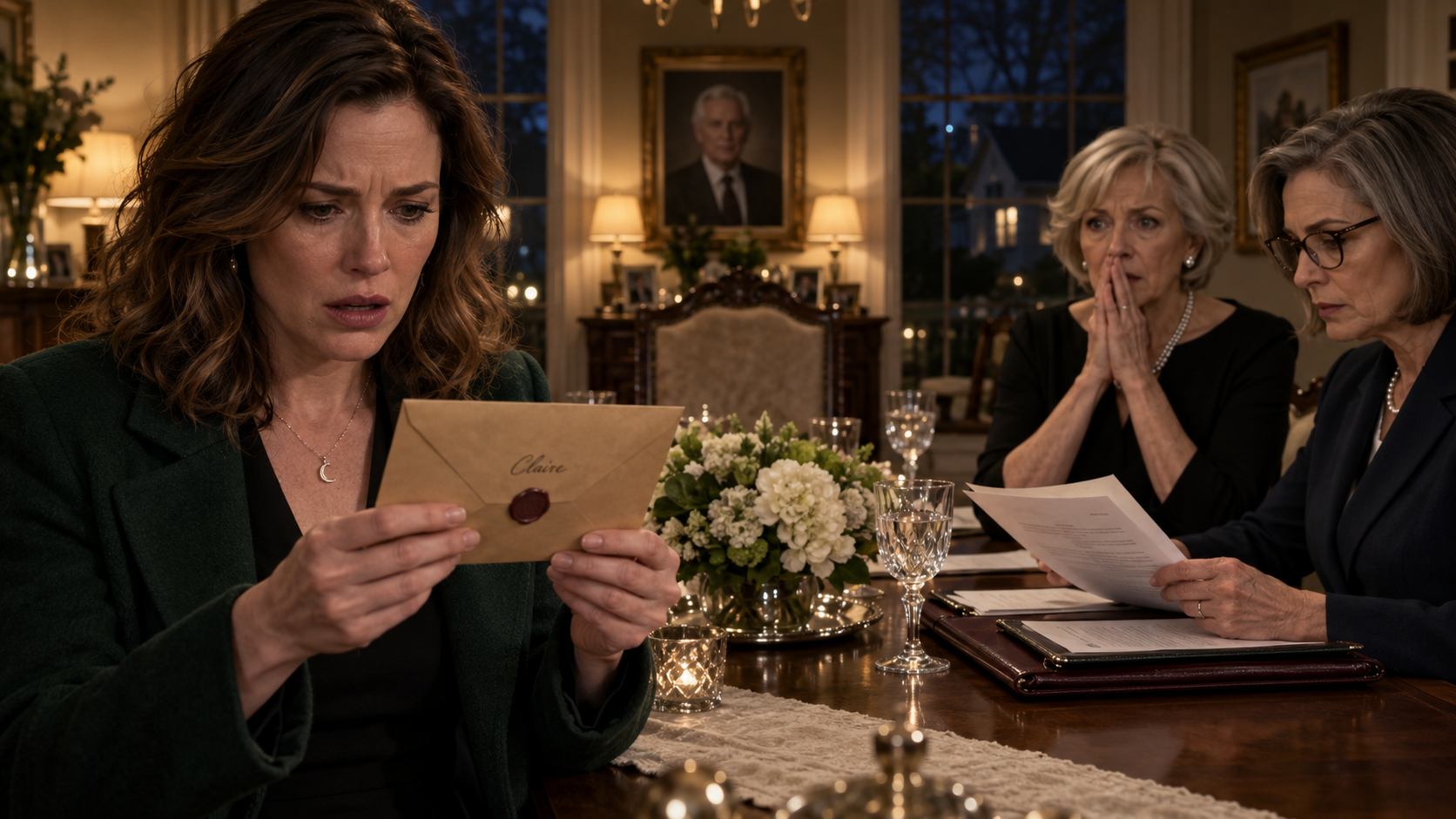
MY FATHER’S WILL WAS READ AT MIDNIGHT — THEN MY MOTHER TOLD THE LAWYER TO SKIP THE LAST PAGE
At 12:17 in the morning, my father’s attorney reached the last page of his will, and my mother told her to stop reading.
Not asked.
Told.
“Margaret, that section isn’t necessary tonight.”
My mother was sitting at the head of the dining room table in the same black dress she had worn to Dad’s visitation six hours earlier. Her pearl earrings were still on. Her lipstick was still perfect.
Margaret Sloan looked over her reading glasses.
“Patricia, Robert specifically instructed me to read the document in full.”
My brother Evan stopped tapping his thumb against his coffee mug.
I remember staring at my mother because her face had changed.
Not dramatically.
That was never Mom’s style.
Her shoulders went rigid. Her right hand closed around the edge of the table.
Then Margaret reached into her burgundy portfolio and placed a sealed brown envelope in front of me.
My name was written across it in my father’s handwriting.
And for the first time in twenty years, my mother looked afraid of something I might learn.
Dad had been dead for four days.
Until that moment, I thought grief was the worst thing waiting for me in that house.
I was wrong.
My father, Robert Bennett, died on a Monday morning in late October after a short, ugly fight with pancreatic cancer.
He was seventy-three.
He had spent most of his adult life running Bennett Home & Hardware, a store just outside Franklin, Tennessee, that smelled like cedar boards, fertilizer, coffee, and the rubber mats he put behind every register because he thought standing on concrete was “how you ruined a good pair of knees.”
My brother Evan had worked there since he was twenty-two.
I had worked there too, though my family had developed a strange habit of forgetting that.
I started helping in the store at fourteen. By sixteen I could mix paint, cut keys, process returns, and tell a customer which aisle had picture hooks without looking up.
At twenty-one I was doing half the bookkeeping.
At twenty-four I left Tennessee for graduate school.
By twenty-six, the official family version was that I had never cared about the business.
That was how things happened in my family.
Not with one large lie.
With small edits.
A sentence changed here.
A motive reassigned there.
After enough years, everyone remembered the edited version.
Everyone except the person it happened to.
Dad’s funeral visitation ended a little after ten that night.
Mom had insisted we return to the house afterward because “there were family matters.”
Margaret Sloan arrived around eleven-thirty.
I thought we were signing something routine.
Death certificates.
Insurance paperwork.
Maybe funeral expenses.
Instead, Margaret told us Dad had left instructions that his immediate family gather in his dining room after midnight once the visitation was over.
“It was important to him that this happen privately,” she said.
My husband Daniel squeezed my hand under the table.
Across from us sat Evan and his wife Brooke.
Sadie, our twelve-year-old daughter, was sleeping at Daniel’s sister’s house. Evan’s thirteen-year-old daughter Lily was with Brooke’s parents.
Dad’s empty chair was six feet from me.
Mom refused to let anyone sit in it.
Margaret began reading at 12:03.
The first several sections were exactly what I expected.
Mom had lifetime use of the family home.
Dad’s personal effects were divided according to a list he had prepared.
Several charitable gifts went to local organizations.
Then came the business.
Dad left his voting interest in Bennett Home & Hardware to Evan.
I felt something old and embarrassing tighten inside my chest.
Even at forty-two, even with a career I loved, a husband who loved me, a daughter who thought I hung the moon, I could still become twenty-four years old in one sentence.
Evan looked at me.
I smiled.
Not because I was happy.
Because smiling had always been cheaper than explaining my face.
Mom exhaled quietly beside him.
“There,” she said. “That’s settled.”
Margaret continued.
Dad left me no ownership interest in the operating business.
Again, not surprising.
Then Margaret said, “Section Five concerns the Bennett Family Restoration Account.”
Mom interrupted.
That was the moment everything changed.
“Margaret, that section isn’t necessary tonight.”
Margaret did not even look annoyed.
She looked prepared.
“Robert requested that it be read.”
“It’s bookkeeping.”
“It concerns Claire directly.”
The room became so quiet I could hear the refrigerator cycling in the kitchen.
Margaret put the envelope in front of me.
Then she placed a thick folder beside it.
The folder was labeled with my grandmother’s name.
Evelyn Bennett.
My father’s mother.
The woman who had paid for my first used car, taught me how to make biscuits without measuring, and died when I was twenty-three.
The woman whose money, according to my parents, had disappeared in the financial crisis before I could use it for graduate school.
I looked at Margaret.
“What is this?”
Mom stood.
“We can handle that another day.”
I can still hear the scrape of her chair.
It was such an ordinary sound.
That is what I remember most about the worst moments of my life.
They usually sound ordinary.
I put my palm over the folder.
“No.”
Mom looked at me.
I had said that word to her thousands of times in my head.
Out loud, apparently, it surprised both of us.
“I want to hear it.”
Her mouth tightened.
“You’ve had an exhausting week.”
“So have you.”
“Claire.”
“Sit down, Mom.”
Daniel turned his head toward me.
Evan stared.
I had never spoken to her that way.
Neither had he.
For a second I almost apologized.
That reflex was so strong it felt physical.
Then Margaret opened the folder.
She read a statement my father had signed eleven months before he died.
In 2007, Grandma Evelyn had left me an investment account valued at just over two hundred and twelve thousand dollars.
I knew that part.
What I had been told was that the account had been aggressively invested and lost most of its value during the 2008 collapse.
Dad had sat with me at this exact table in early 2009 and said, “I’m sorry, sweetheart. There just isn’t enough left to make a difference.”
I remembered crying in my car afterward.
Not because I believed my parents owed me tuition.
Because Grandma had wanted to give me something, and it was gone.
I took loans.
I worked weekends.
Daniel and I delayed buying a house.
We ate a lot of rice, eggs, and whatever vegetables were cheap.
I was proud of us.
I never blamed Dad for the market.
Margaret turned one page.
“The account,” she read, “did not sustain the losses previously represented to Claire Bennett Walker.”
I thought I had misunderstood.
“What?”
Margaret looked at me.
“In March of 2009, assets from the Evelyn Bennett account were pledged as collateral for emergency financing associated with Bennett Home & Hardware.”
Evan frowned.
“No.”
Margaret continued.
The business had been in serious trouble.
Dad had expanded into a second location in 2007.
Then housing collapsed.
Contractors stopped buying.
Credit tightened.
The second store bled cash.
Evan had personally guaranteed part of the expansion.
If the loan had defaulted, he and Brooke could have lost their house.
Dad and Mom used my inheritance to help secure refinancing.
I stared at my brother.
He looked genuinely confused.
Then he said something that changed everything again.
“Claire agreed to that.”
I laughed.
One sharp sound.
“What?”
Evan leaned forward.
“Dad told me you agreed. He said you weren’t going to school for another year and you said they could use it temporarily.”
I looked at Mom.
She had gone very still.
“I was already accepted.”
Evan shook his head.
“That’s not what I was told.”
“I moved to Nashville that August.”
“I know.”
“Then how exactly was I not going to school?”
He opened his mouth.
Closed it.
Mom spoke before he could.
“This was seventeen years ago.”
“Seventeen?” I said. “It happened seventeen years ago, so it doesn’t count?”
“No one said that.”
“What did you tell him?”
She looked at me like I was being unreasonable at a restaurant.
“Your father handled the finances.”
Margaret quietly said, “Patricia, your signature appears on the authorization documents.”
That was the first crack.
Mom turned toward her.
“Robert and I were married. Of course my signature is on documents.”
“Did I agree?” I asked.
Mom looked back at me.
She did not answer.
That silence was louder than anything she could have said.
Evan pushed his mug away.
“Mom?”
“You were both very young.”
I nearly smiled because Evan had been twenty-eight.
He had a mortgage and a toddler.
I was twenty-five.
Apparently adulthood in my family had always arrived at different ages depending on who needed protecting.
Margaret continued.
Dad had spent years repaying money into a separate account.
Not all at once.
Some years five thousand.
Some years twenty.
After he sold the second store property, much more.
By the time he died, the account contained three hundred and forty-eight thousand dollars.
Principal plus what he had calculated as reasonable growth.
It was mine.
Not part of the estate.
Not something I had to fight Evan for.
Dad had legally separated it months before his diagnosis became public.
The envelope contained a personal letter.
I did not open it that night.
I couldn’t.
There is a limit to how much truth you can absorb while wearing funeral clothes.
Mom tried to make me feel ashamed before I had even left the table.
That was familiar enough to almost be comforting.
She folded her hands.
“Your father made this right.”
“No,” I said. “He paid money back.”
“That’s what making it right means.”
“No. That’s accounting.”
She stared at me.
Daniel’s hand settled on my shoulder.
I said, “Making it right would have been telling me.”
Mom’s expression hardened.
“You have no idea what was at stake.”
“The store?”
“Our entire family.”
I glanced at Evan.
He was looking down.
“The store was the family?” I asked.
“You know what I mean.”
I did.
That was the problem.
I always knew what she meant.
When Mom said family, she usually meant the structure that made her feel safe.
Dad at the store.
Evan beside him.
Mom organizing everyone.
Me agreeable enough to remain nearby but independent enough not to require anything.
My job was to need less and call it strength.
I drove home with the envelope unopened in my purse.
Daniel did not speak until we were halfway to our neighborhood.
Then he said, “I’m sorry.”
I looked out the passenger window.
At midnight, Franklin’s streets were mostly empty. Porch lights glowed on brick houses. Halloween pumpkins sat on steps.
“For what?”
“For every time I told you maybe you remembered it harsher than it was.”
That hurt almost as much as Mom.
I turned toward him.
He kept his eyes on the road.
“I thought your mom was difficult,” he said. “I didn’t think she was lying to both of you.”
“You told me to let things go.”
“I know.”
“A lot.”
“I know.”
I wanted to punish him with silence.
Instead I said the truest thing I had.
“I needed one person to believe me before there was paperwork.”
He nodded.
“I know.”
We drove another mile.
Then he said, “I believe you now.”
I stared out the window again.
“That’s not exactly the same thing.”
“No.”
At home I put Dad’s envelope in my desk drawer.
I did not open it for three days.
The first person in the family to call me was Evan.
I watched his name flash across my phone while I was sitting in the parking lot outside the clinic where I worked.
I almost let it go to voicemail.
Then I answered.
“Hey.”
He sounded exhausted.
“Did you know?”
“Know what?”
“That Mom told me you volunteered the money.”
“No.”
Silence.
Then he said, “I swear to you, Claire.”
I closed my eyes.
When we were children, Evan could not lie convincingly.
His ears turned red.
Even over the phone, I somehow remembered that.
“I believe you,” I said.
He exhaled.
“I don’t know if that makes it better or worse.”
“Neither do I.”
He told me the version he had grown up with.
I had wanted graduate school.
Dad thought it was impractical.
We fought.
I decided I wanted no part of the store.
Then, during the crisis, I supposedly told Dad to use Grandma’s account because I wanted to prove I did not need the family’s money.
It was exactly the kind of stubborn, dramatic gesture my mother liked to attribute to me.
It was also completely invented.
“Why didn’t you ever thank me?” I asked.
Evan was quiet.
“I thought Dad told me not to bring it up.”
“Why?”
“He said you were embarrassed afterward.”
I laughed again.
This family had apparently built an entire bridge out of conversations no one was allowed to have.
I asked Evan what he remembered about 2009.
He remembered Dad barely sleeping.
Mom taking over bills.
Brooke crying because they thought they might lose their house.
He remembered me visiting one Sunday before moving to Nashville.
“You were mad,” he said.
“I was upset about the account.”
“I thought you were mad because Dad had asked for it.”
“No one asked me.”
Another silence.
Then Evan said, “Jesus.”
I opened Dad’s letter that night.
His handwriting shook more than it had on the envelope.
Claire,
I should have told you this while I could sit across from you and take whatever anger you gave me.
I did not.
That was cowardice.
Your mother will tell you we did what we had to do.
I told myself the same thing for years.
The store was in trouble. Evan was in trouble. I believed I could borrow from your account and replace it before you needed to know.
When I could not replace it quickly, I let your mother convince me that telling you would only create resentment.
The resentment came anyway.
It simply landed on you instead of me.
I stopped reading.
There was more, but I put the paper on my desk and cried so hard Daniel came upstairs.
He didn’t ask what was wrong.
He sat on the floor beside my chair.
After a while I handed him the letter.
Dad wrote that he had watched Mom describe me as difficult whenever I asked reasonable questions.
He had watched Evan assume I did not care about the business.
He had watched me pull farther away.
And every year he thought the next year would be easier to tell the truth.
It never was.
Near the end of the letter he wrote:
I loved you, but I often loved you privately when I should have defended you publicly.
Do not confuse my silence with your lack of worth.
I read that sentence more than any other.
For most of my life, I had imagined an apology from my father would feel like relief.
It did not.
It felt like someone handing me an umbrella after I had already lived through the storm.
Useful.
Kind.
Late.
The next Sunday, Mom invited us to lunch.
I said no.
She called again Monday.
I said no.
By Wednesday she sent a group text to me, Evan, Brooke, and Daniel.
We need to discuss the estate as adults. Your father wanted the family protected.
Evan replied first.
What specifically?
Mom wrote:
There are documents Claire needs to sign so the business is not damaged unnecessarily.
I called Margaret.
“What documents?”
There was a pause.
“Your mother asked me about a family settlement agreement.”
“For what?”
“She appears concerned you may pursue additional claims related to the historic use of your grandmother’s assets.”
“Can I?”
“Potentially.”
“Am I?”
“You have not instructed me to.”
That distinction mattered.
Mom was fighting a war I had not declared.
Margaret explained that Dad’s repayment account solved part of the financial issue but did not erase questions around how the original transfer occurred.
I told her I needed time.
Then Mom did what she always did when direct pressure failed.
She became kind.
She dropped soup at our house.
She sent Sadie a gift card.
She texted me a photograph of Dad holding me as a baby.
Your father hated conflict, she wrote. Please remember that.
I almost threw my phone.
Not because the message was cruel.
Because it was perfectly designed.
Dad hated conflict.
Therefore, if I created conflict, I was dishonoring him.
It took me years to recognize how often my mother turned someone else’s feelings into my responsibility.
The following Friday, Sadie came home from school quieter than usual.
She dumped her backpack near the kitchen island and asked if she could go upstairs.
I knew that tone.
I used it myself.
“What happened?”
“Nothing.”
“Okay.”
She made it three steps.
Then she turned around.
“Is Grandma mad at me?”
My stomach dropped.
“Why would Grandma be mad at you?”
Sadie shrugged.
“She called yesterday.”
Daniel had mentioned Mom called while I was working late. I assumed she wanted to check on us.
“What did she say?”
“She asked if I was excited about Lily’s horse camp.”
I blinked.
“What horse camp?”
Sadie’s expression changed.
She had just realized I did not know.
Apparently Mom had offered to pay for Lily to attend a two-week riding program the next summer.
Sadie had been taking riding lessons for two years.
Lily had never ridden.
That alone did not make Mom a monster.
Grandparents do different things with different grandchildren.
What mattered was what came next.
Sadie had asked whether she could go too.
Mom told her the camp was expensive.
Sadie said she had birthday money saved.
Then Mom said, “Sweetheart, not everything has to be equal.”
That sentence was so familiar I felt cold.
I heard it when Evan got a truck at seventeen and I got access to Mom’s old Buick.
Not everything has to be equal.
When his wedding reception cost almost three times what my parents contributed to ours.
Not everything has to be equal.
When Dad paid the down payment on Evan’s first house and told me Daniel and I were “better with money anyway.”
Not everything has to be equal.
Sadie looked at me.
“I wasn’t trying to be spoiled.”
I crossed the kitchen and hugged her.
“I know.”
“I like Lily.”
“I know.”
“Please don’t fight with Grandma because of me.”
There it was.
Twelve years old.
Already learning that noticing unfairness made you responsible for the fight.
Something in me shifted.
Not exploded.
Shifted.
That distinction matters.
Real change did not arrive as courage.
It arrived as recognition.
I heard my daughter apologize for having eyes.
And suddenly I understood what staying quiet was teaching her.
That evening I called Mom.
Daniel sat beside me.
I put the phone on speaker.
“Why did you call Sadie about Lily’s camp?”
Mom sighed.
“Claire, please.”
“Why did you call her?”
“I was trying to include her in the excitement.”
“By telling her she couldn’t go?”
“I never said she couldn’t go.”
“You told her not everything has to be equal.”
“Well, it doesn’t.”
“Why are you paying for Lily?”
“Evan and Brooke have had a difficult year.”
“And we haven’t?”
“You and Daniel are comfortable.”
“So because we manage our money, Sadie gets less?”
“That is not what I said.”
Daniel looked at me.
I stayed quiet.
Mom filled the silence.
“Lily needs something positive.”
“Then give Lily something positive.”
“Exactly.”
“But don’t make Sadie the audience for it.”
Another sigh.
“You’re turning this into your childhood.”
“No. You are repeating my childhood with my daughter.”
Her voice sharpened.
“That is unfair.”
I almost apologized.
Then I remembered Sadie standing in the kitchen.
“No,” I said. “It’s accurate.”
Mom hung up on me.
The next morning Evan called.
“What did you say to Mom?”
That old dynamic snapped into place so quickly I almost laughed.
“She called you.”
“She’s crying.”
“I’m sure she is.”
“Claire.”
“No. You don’t get to ‘Claire’ me before asking what happened.”
He went quiet.
Then, to his credit, he asked.
So I told him.
He did not defend Mom.
Instead he said, “I didn’t know she told Sadie about camp.”
“Did you know she offered to pay?”
“Yeah.”
“Did you know Sadie rides?”
“Of course.”
“Did that strike you as odd?”
Another silence.
“Not until right now.”
That answer was painful, but believable.
Privilege does not always feel like favoritism to the person receiving it.
Sometimes it just feels normal.
Evan said he would talk to Mom.
I told him not to fix it.
“I need her to understand the problem isn’t whether Sadie gets camp too.”
“Then what is it?”
“That she creates these little competitions and then acts offended when somebody notices.”
He was quiet.
Finally he said, “You think she did that to us?”
“Yes.”
He did not argue.
Two days later, Brooke asked to meet me for coffee.
She chose a place in Nashville, halfway between us.
We sat near the window.
She looked nervous.
“I found something.”
She slid an old accordion folder across the table.
Evan had been going through boxes from Dad’s office.
Inside were loan papers, tax statements, notes.
One sheet was a copy of an email Dad had printed in 2009.
The sender was Mom.
The recipient was Dad.
The message was short.
Claire will make this about fairness if we tell her now. Evan cannot know she did not agree, or he’ll refuse the money out of pride. We solve the immediate problem first. Later, once the store is stable, we can explain.
I read it twice.
Brooke’s eyes filled.
“I’m sorry.”
“You didn’t write it.”
“I benefited from it.”
“So did Evan.”
“That doesn’t mean I don’t feel awful.”
I looked through the rest.
There were handwritten notes from Dad.
Amounts.
Dates.
Transfers.
One note from 2011 said:
Pat says wait until after Claire’s baby. No reason to upset her now.
Another from 2013:
Pat says Claire is doing fine and telling her would only reopen old wounds.
2015:
Need to tell C.
2017:
After holidays.
2019:
No good time.
He had documented his cowardice like a recurring appointment.
That was the midpoint for me.
Until then, I had believed the secret was financial.
It wasn’t.
The money was simply where the truth left fingerprints.
The real secret was that my parents had spent years making decisions about what I was allowed to know based on what kept the family easiest to manage.
And they had done the same thing to Evan.
I called him from the parking lot.
“Brooke showed me the email.”
“I know.”
“What do you think?”
“I think I’m an idiot.”
“You were lied to.”
“I still didn’t ask enough questions.”
“Neither did I.”
“You did ask questions.”
I looked through the windshield at people carrying shopping bags through the parking lot.
“Not after a while.”
He was quiet.
Then he said, “Because they made you regret asking.”
That sentence came from my brother.
Not a therapist.
Not Daniel.
Not a friend.
My brother.
For some reason that was the first moment I cried for the relationship Evan and I might have had.
The next week, Mom invited the extended family to Sunday dinner.
I did not plan to go.
Then Aunt Susan called me.
Mom’s younger sister.
“I think you should come,” she said.
“Why?”
“Because your mother is telling people you’re threatening the business.”
I closed my eyes.
“Of course she is.”
“She says Robert repaid you and now you want more.”
“I haven’t filed anything.”
“I figured.”
“Then why should I go?”
Aunt Susan hesitated.
“Because she’s making your silence part of her story again.”
That got me.
So we went.
Daniel drove.
Sadie stayed with his sister.
Before we got out of the car, Daniel said, “If you want to leave, we leave.”
“Even if Mom cries?”
“Yes.”
“Even if Evan gets mad?”
“Yes.”
“Even if everyone thinks I’m dramatic?”
He looked at me.
“I care less about everyone than I used to.”
I smiled despite myself.
“Growth.”
“Slow growth.”
Mom had set the dining table like Thanksgiving.
Roast chicken.
Green beans.
Potatoes.
Her mother’s china.
Aunt Susan and her husband were there.
Evan, Brooke, and Lily were there.
Two family friends from church were there, which told me immediately that this was not just dinner.
Mom liked witnesses when she expected to look gracious.
We got through forty minutes of small talk.
Then coffee came out.
Mom folded her napkin.
“I think we need to address something before misunderstandings damage Robert’s legacy.”
Daniel’s jaw tightened.
Evan looked at her.
“Mom.”
“No. We are all adults.”
She turned toward me.
“Claire has discovered that many years ago, during a financial crisis, her father temporarily used family assets to protect the business.”
“Family assets?” I said.
Her eyes flashed.
“I’m trying not to make this uglier than necessary.”
“By changing what happened?”
Aunt Susan looked down at her coffee.
Mom continued.
“Robert restored every dollar and more. Unfortunately, Claire is considering legal action that could force Evan to sell the business.”
Everyone looked at me.
There it was.
The old trick.
Tell the story first.
Let me spend the rest of the evening correcting it.
I set my coffee down.
“I haven’t filed a lawsuit.”
Mom blinked.
“I didn’t say you had.”
“You said I’m considering legal action that could force Evan to sell.”
“Are you saying you aren’t?”
“I’m saying you don’t get to announce my private legal options as if I’ve made a decision.”
“You spoke to an attorney.”
“The estate attorney.”
“Exactly.”
“No,” I said. “Not exactly.”
Evan leaned forward.
“Mom, stop.”
She turned on him.
“I am protecting what your father built.”
“No. You’re putting this on Claire.”
“I’m explaining facts.”
Brooke said quietly, “Then explain the email.”
Mom went pale.
Aunt Susan looked up.
“What email?”
Mom stared at Brooke.
“That was private correspondence.”
“So was Claire’s inheritance,” Brooke said.
For once, Mom did raise her voice.
“This family would have lost everything!”
Evan stood.
“No. We might have lost the store.”
“You would have lost your home.”
“Then you should have told me where the money came from.”
“You would have refused.”
“Maybe.”
“Exactly.”
He stared at her.
“That wasn’t your decision.”
Mom looked at him as though he had slapped her.
“You have no idea what I did for you.”
Evan’s face changed.
Not angry.
Tired.
“I’m starting to.”
The room broke apart after that.
Aunt Susan began asking questions.
Mom accused Brooke of snooping.
One of the church friends suddenly remembered an early morning appointment.
Daniel stood beside me.
And Lily, thirteen years old, sat frozen at the end of the table.
That was enough.
I stood.
“We’re done.”
Mom turned toward me.
“Of course you’re leaving.”
“Yes.”
“You always leave when things get uncomfortable.”
I put on my coat.
“No, Mom. I used to stay until everyone was comfortable except me.”
She opened her mouth.
I did not wait.
Daniel and I left.
My hands shook all the way to the car.
Inside, I started crying.
“I sounded ridiculous.”
“No.”
“I should have said more.”
“You said enough.”
“I should have stayed calm.”
“You were calm.”
“I left.”
“Yes.”
He started the car.
Then he said, “Leaving was the calm part.”
Three days later, Evan showed up at our house.
Alone.
He had a cardboard box in his arms.
Daniel let him in.
We sat at the kitchen table.
Evan put the box between us.
“I found Dad’s journals.”
Not diaries.
Dad would have hated that word.
They were small accounting notebooks.
He wrote business notes in them.
Inventory.
Employee names.
Reminders.
But near the end, he had started writing about us.
Evan opened one.
March 14, 2025.
P says C has always resented E. Truth is I taught her that asking meant trouble.
Another entry:
E thinks C abandoned store. C thinks E took everything willingly. Both stories convenient for me.
I read that one three times.
Dad had understood.
Late.
But completely.
Evan rubbed his face.
“I don’t know what to do with this.”
“Neither do I.”
“I spent years thinking you looked down on me.”
“I spent years thinking you were happy to take everything.”
“I wasn’t happy.”
“You didn’t look miserable.”
He almost smiled.
“That’s fair.”
I made coffee.
For the first time in maybe fifteen years, my brother and I talked without either parent present.
Not about logistics.
Not birthdays.
Not Dad’s health.
About us.
He told me he had envied my career.
I laughed.
“You owned a business.”
“I inherited a job I was terrified to fail at.”
“You loved the store.”
“I did. I still do. That doesn’t mean I knew whether I chose it.”
That stopped me.
I told him I had envied his certainty.
He looked surprised.
“You always acted like you knew exactly what you were doing.”
“So did you.”
We both laughed then.
It was not reconciliation.
Not yet.
It was stranger.
We were meeting each other without our parents translating.
A week later, Margaret called.
Mom had asked Evan to sign documents moving several estate assets into the business before probate was complete.
Evan refused.
Then Mom asked me directly to sign a waiver confirming I would pursue no claims related to the historic account.
I refused.
She came to my house that evening.
No warning.
Daniel opened the door.
Mom stood on the porch wearing a camel-colored coat, pearls, and an expression I knew from childhood.
Composed injury.
“I need to speak to my daughter.”
Daniel looked at me.
I said, “You can come in for twenty minutes.”
Mom entered.
I kept us in the living room.
Not the kitchen.
The kitchen felt too intimate.
She sat on the sofa.
I sat across from her.
Daniel stayed nearby.
She noticed.
“Do we need an audience?”
“Yes.”
That surprised her.
“Claire.”
“Twenty minutes.”
She looked down at her hands.
“I made mistakes.”
It was the closest thing to an apology she had offered.
I waited.
“But your father and I were trying to survive.”
There was the turn.
I said nothing.
“The economy collapsed. Employees depended on us. Evan had a new baby. Your father was barely sleeping.”
“I know.”
“You were always the capable one.”
I almost laughed.
There it was.
The compliment that had cost me hundreds of thousands of dollars.
“You could recover,” she continued. “Evan couldn’t.”
“You didn’t know that.”
“I knew my children.”
“No. You assigned us roles.”
Her face tightened.
“I refuse to be analyzed in my own family.”
“I’m not analyzing you. I’m describing what happened.”
“You have always believed Evan was favored.”
“He was.”
“We helped him because he needed more help.”
“And then you punished me for needing less.”
“That is not fair.”
“Not everything has to be equal, right?”
She froze.
I had used her line.
For the first time, she heard how it sounded from the other side.
She looked toward Daniel.
“This is exactly what I was afraid of. Your wife is turning every act of love into evidence.”
Daniel answered before I could.
“No.”
Mom blinked.
He rarely challenged her directly.
He said, “Claire spent years turning evidence into excuses for you.”
I looked at him.
Mom stood.
“I will not sit here and be attacked.”
I stood too.
“No one is attacking you.”
“You’re threatening your brother’s livelihood.”
“Evan and I are discussing the business together.”
That shocked her more than anything.
Her face changed.
“What?”
“He knows what I’m doing.”
“You’ve involved him?”
“He is my brother.”
“I know who he is.”
“Do you?”
Silence.
She picked up her handbag.
Then she tried the last tool she had.
“Your father would be devastated.”
My chest tightened.
For half a second, I was thirty years old again.
Then I remembered Dad’s letter.
I loved you privately when I should have defended you publicly.
I looked at Mom.
“Dad spent his last year trying to correct what silence did to us.”
Her eyes filled.
“You think a letter means you understood your father better than I did?”
“No.”
I walked to the front door.
“I think it means he finally understood himself.”
She left without saying goodbye.
Two weeks later, Margaret arranged one final family meeting at Dad’s request.
There was another document.
Not a legal surprise.
A letter addressed to all four of us: Mom, Evan, me, and our spouses.
We met in Margaret’s office in Franklin.
Daylight this time.
I was grateful for that.
Some truths do not need midnight.
Margaret gave each of us a copy.
Dad had written it before he entered hospice.
Patricia,
I let you carry too much of our fear.
Then I let your fear become our family’s rules.
That was my failure as much as yours.
Evan,
I confused protecting you with preparing you.
I solved too many problems before you had the chance to solve them yourself.
Claire,
I confused your independence with permission to give you less.
Because you survived disappointment, I kept disappointing you.
I had to stop reading again.
Across the table, Evan pressed his fingers against his eyes.
Mom stared straight ahead.
Dad continued:
I hope neither of you spends the rest of your life deciding which child was loved more.
You were loved differently.
Sometimes badly.
Sometimes selfishly.
Sometimes fearfully.
That does not mean you have to keep living inside the roles we gave you.
The final section addressed the business.
Dad had left Evan operational control, but the building itself was held separately by the estate.
He instructed that Evan either purchase the property at a favorable but legitimate valuation or sell the business assets to a third party.
Part of the proceeds would restore additional money Dad believed had indirectly benefited Evan over the years.
Not as punishment.
As accounting.
Evan nodded before Margaret finished.
“I’ll sell the second parcel.”
Mom turned sharply.
“No.”
He looked at her.
“Yes.”
“Your father built that property.”
“And nearly lost both of us trying to save it.”
“That is not what he wanted.”
Evan held up the letter.
“It is literally what he wrote.”
Mom’s face crumpled.
For the first time, she did not look controlling.
She looked seventy.
Widowed.
Terrified.
And suddenly I understood something that did not excuse her but did make her human.
My mother had built her identity around preserving the family.
The house.
The store.
The holidays.
The photographs.
The version of us she could explain to other people.
If the store shrank, if Evan admitted weakness, if I refused to play the difficult daughter, then the structure she had spent forty years maintaining was not stable.
She was not fighting only for money.
She was fighting to keep her life story intact.
Understanding that helped me.
It did not make me surrender.
Mom looked at me.
“Are you happy now?”
I could have said yes.
A younger version of me might have wanted to.
Instead I said, “No.”
That seemed to confuse her.
“I buried my father a month ago. I found out both my parents lied to me for seventeen years. My brother and I lost years being angry at each other for things neither of us understood.”
I took a breath.
“I’m not happy.”
She looked away.
“But I am done pretending that keeping you comfortable is the same thing as keeping this family together.”
She whispered, “You’re tearing it apart.”
“No.”
I kept my voice low.
“This was already broken. I’m just not putting the tablecloth back over it.”
No one spoke.
Then I said the thing I had needed to learn more than anything.
“You can be my mother without being in charge of my memory.”
Mom’s face changed.
Not with revelation.
Real life rarely gives you that.
People do not hear one perfect sentence and transform.
She looked angry.
Then hurt.
Then defensive.
Then small.
“You’ll regret speaking to me this way.”
“Maybe.”
I stood.
“But regret is not the same thing as being wrong.”
That was our final confrontation.
Not screaming.
No shattered glasses.
No dramatic confession.
Just a seventy-year-old woman realizing that the daughter she had always been able to bring back into line with guilt was no longer moving.
The next several months were messy.
Evan sold the unused second parcel and refinanced the main store property.
He did not lose the business.
He reduced it.
For him, that distinction became important.
Bennett Home & Hardware went from something he had to preserve at any cost to something he actually chose to operate.
Brooke told me he started coming home earlier.
He hired a bookkeeper instead of doing everything himself.
He even took Lily to Florida for spring break without checking whether Mom approved of closing the store for three days.
That may sound small.
In our family, it was practically revolutionary.
The money Dad had set aside for me remained mine.
I used a portion to finish paying off our mortgage.
Daniel and I put money into Sadie’s college account.
I also created a modest fund for adaptive equipment at the pediatric clinic where I worked.
I did not do that to prove I was generous.
That mattered to me.
For most of my life, I had performed goodness in advance of being accused of selfishness.
I wanted to make choices because they were mine.
Mom and I went low contact.
We did not use that phrase with her.
We simply stopped answering every call.
Stopped attending every dinner.
Stopped explaining every no.
At first she escalated.
Then she recruited Aunt Susan.
Aunt Susan declined the job.
Then she sent long emails.
I responded once:
I love you. I am willing to have a relationship with you. I am not willing to participate in conversations where my boundaries are described as punishment.
Mom did not answer for nine days.
On the tenth day, she texted:
Would Sadie like to come for lunch Saturday?
I asked Sadie.
She said yes.
Then she added, “Only if you come too.”
So I did.
Mom did not mention horse camp.
She did not apologize.
She made grilled cheese and tomato soup.
Sadie talked about school.
I stayed for ninety minutes.
Then we left.
Progress in my family stopped looking like dramatic reconciliation.
It started looking like ninety peaceful minutes with an exit plan.
Six months after Dad died, Evan and Brooke came to our house for Sunday dinner.
Lily and Sadie were in the backyard trying to teach our dog to jump over a broomstick.
Daniel grilled burgers.
Evan brought potato salad from the grocery store and transferred it into a ceramic bowl because he said he knew I would judge him.
“I absolutely would not,” I said.
“You’re already judging me.”
“I’m judging the transfer. It’s dishonest.”
He laughed.
That laugh sounded different from the ones we used at Mom’s table.
No defense inside it.
No performance.
Later, after dinner, Evan and I sat on the back steps.
The girls were arguing about whether the dog deserved a treat for walking around the broom instead of over it.
Evan said, “Do you think Dad knew this would happen?”
“What?”
“Us.”
I thought about it.
“I think he hoped.”
Evan nodded.
“He should have told us sooner.”
“Yes.”
“I should have asked more.”
“Yes.”
He glanced at me.
“You’re not making this easy.”
“I spent twenty years being easy.”
He smiled.
“Fair.”
We sat quietly.
I still missed Dad.
That surprised me sometimes.
You can be furious with a person and still miss them.
You can forgive part of someone and remain angry about another part.
You can understand why they failed you without deciding the failure did not matter.
Those were adult truths no one taught me when I was young.
Mom did not come to Sunday dinner.
I did not invite her.
Maybe one day I would.
Maybe not.
For years I thought healing meant getting my old family back, only kinder.
I no longer wanted that.
The old version required too many people to stay in character.
Evan had to be the son who needed saving.
I had to be the daughter who needed nothing.
Dad had to be the good man who never chose sides.
Mom had to be the woman holding everyone together.
Once we stopped performing those parts, there was less family at first.
But what remained was real.
As the sun went down, Sadie and Lily came inside carrying the broom and laughing so hard neither could explain what had happened.
Daniel opened the back door.
Evan stood beside me.
For the first time in years, being with my family did not feel like waiting to be misunderstood.
And I finally learned that home is not the place where everyone stays.
Home is the place where no one has to disappear to keep the peace.